Examples
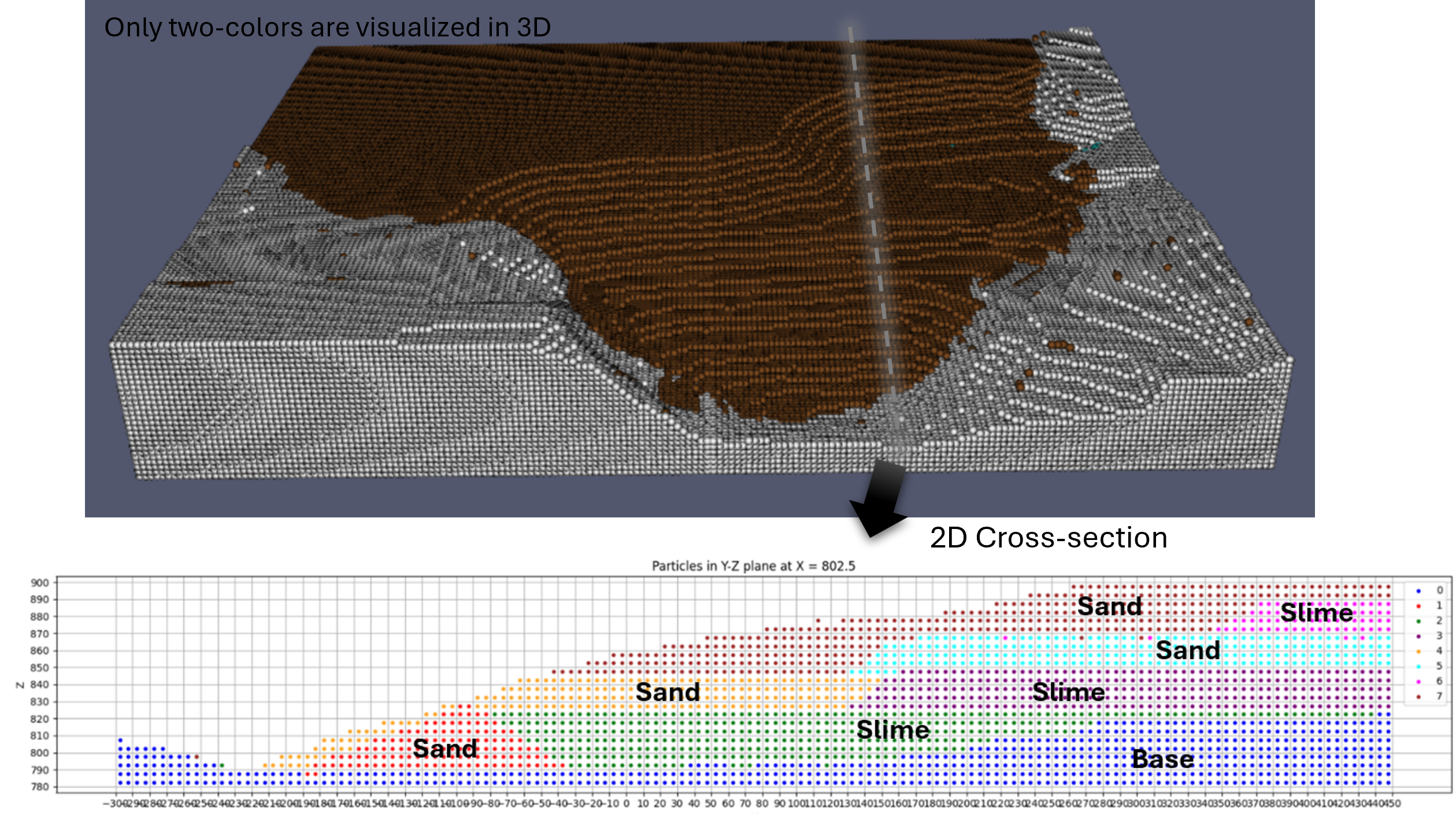
Make 3D topography model from mesh files
This example generates material point method model from external mesh.obj files which defines layer boundaries of
ground of mountain.
import sys
sys.path.append('/work2/08264/baagee/frontera/cbgeopy')
import utils
from mpm import MPMConfig
import demo_utils
from functools import partial
import numpy as np
import vis_utils
import os
import trimesh


save_dir = './'
# Replace the data_dir to the directory containing the obj surface meshes
data_dir = '/work2/08264/baagee/frontera/fundao/fundao_3d-8/'

# Create surface
mesh_base = utils.obj2mesh(f'{data_dir}/mesh_0_v2.obj')  # base
mesh_dike = utils.obj2mesh(f'{data_dir}/mesh_1_v2.obj')  # dike
mesh_sand1 = utils.obj2mesh(f'{data_dir}/mesh_2_v2.obj')  # sand (or slime)
mesh_slime1 = utils.obj2mesh(f'{data_dir}/mesh_2_slime.obj')  # slime-1
mesh_sand_right = utils.obj2mesh(f'{data_dir}/mesh_2_right_sand.obj')  # sand right
mesh_sand2 = utils.obj2mesh(f'{data_dir}/mesh_7.obj')  # sand
mesh_sand3 = utils.obj2mesh(f'{data_dir}/mesh_7_sand.obj')  # sand below slime-2
mesh_slime2 = utils.obj2mesh(f'{data_dir}/mesh_7_slime.obj')  # slime-2
mesh_top = utils.obj2mesh(f'{data_dir}/mesh_8.obj')  # sand
mesh_top_ref = utils.obj2mesh(f'{data_dir}/mesh_top.obj')  # reference top surface for stress initialization


# Make it to trimesh object
floor = demo_utils.gen_surface_mesh(
    [200, 1130], [-850, 450], 10, partial(demo_utils.generate_slope, slope_angle=0, z_min=740, amplitude=0),
    # [180, 1150], [-300, 450], 10, partial(demo_utils.generate_slope, slope_angle=0, z_min=740, amplitude=0),
    plot=False)
mesh_base = trimesh.Trimesh(*mesh_base)
mesh_dike = trimesh.Trimesh(*mesh_dike)
mesh_sand1 = trimesh.Trimesh(*mesh_sand1)
mesh_slime1 = trimesh.Trimesh(*mesh_slime1)
mesh_sand_right = trimesh.Trimesh(*mesh_sand_right)
mesh_sand2 = trimesh.Trimesh(*mesh_sand2)
mesh_sand3 = trimesh.Trimesh(*mesh_sand3)
mesh_slime2 = trimesh.Trimesh(*mesh_slime2)
mesh_top = trimesh.Trimesh(*mesh_top)
mesh_top_ref = trimesh.Trimesh(*mesh_top_ref)


# # See surfaces
# vis_utils.plot_surfaces(floor, mesh_base, mesh_sand_up, mesh_top, save_path='./surface.html')

# Set config
lx, ly, lz = 1130 - 200, 450 - (-850), 950 - 740
mpm = MPMConfig(domain_origin=[200, -850, 740], domain_length=[lx, ly, lz])
# lx, ly, lz = 1150 - 180, 450 - (-300), 950 - 780
# mpm = MPMConfig(domain_origin=[180, -300, 780], domain_length=[lx, ly, lz])

# Mesh
cell_size = 10
mpm.add_mesh(
    n_cells_per_dim=[int(lx/cell_size), int(ly/cell_size), int(lz/cell_size)])

# Add materials
mpm.add_materials(
    [
        {
            "id": 0,
            "name": "liq_sand",
            "density": 2200,
            "youngs_modulus": 4e6,
            "poisson_ratio": 0.30,
            "friction": 0.0,
            "dilation": 0.0,
            "cohesion": 10e3,
            "tension_cutoff": 10,
            "softening": False,
            "peak_pdstrain": 0.0,
            "residual_friction": 45.0,
            "residual_dilation": 0.0,
            "residual_cohesion": 0.0,
            "residual_pdstrain": 0.0,
            "type": "MohrCoulomb3D"
        },
        {
            "id": 1,
            "density": 2200,
            "name": "slime",
            "youngs_modulus": 2e6,
            "poisson_ratio": 0.30,
            "friction": 0.0,
            "dilation": 0.0,
            "cohesion": 50e3,
            "tension_cutoff": 10,
            "softening": False,
            "peak_pdstrain": 0.0,
            "residual_friction": 45.0,
            "residual_dilation": 0.0,
            "residual_cohesion": 0.0,
            "residual_pdstrain": 0.0,
            "type": "MohrCoulomb3D"
        },
        {
            "id": 2,
            "name": "bedrock",
            "type": "LinearElastic3D",
            "density": 2600,
            "youngs_modulus": 8e6,
            "poisson_ratio": 0.3
        },
        {
            "id": 3,
            "name": "sand",
            "density": 2200,
            "youngs_modulus": 4e6,
            "poisson_ratio": 0.30,
            "friction": 30.0,
            "dilation": 0.0,
            "cohesion": 1000,
            "tension_cutoff": 100,
            "softening": False,
            "peak_pdstrain": 0.0,
            "residual_friction": 45.0,
            "residual_dilation": 0.0,
            "residual_cohesion": 0.0,
            "residual_pdstrain": 0.0,
            "type": "MohrCoulomb3D"
        },
        {
            "id": 10,
            "name": "geostatic_le",
            "type": "LinearElastic3D",
            "density": 2200,
            "youngs_modulus": 8e6,
            "poisson_ratio": 0.3
        }
    ]
)

n_particle_per_cell = 2
z_find_method = 'linear'
z_fill_method = 'round'
overlap_tolerance = 1
mpm.add_particles_from_topography(
    lower_topography=floor,
    upper_topography=mesh_base,
    n_particle_per_cell=n_particle_per_cell,
    material_id=10,
    particle_group_id=0,
    z_find_method=z_find_method,
    base_find_method='simple',
    z_fill_method=z_fill_method,
    overlap_tolerance=overlap_tolerance
)
mpm.add_particles_from_topography(
    lower_topography=mesh_base,
    upper_topography=mesh_dike,
    n_particle_per_cell=n_particle_per_cell,
    material_id=10,
    particle_group_id=1,
    z_find_method=z_find_method,
    base_find_method='simple',
    z_fill_method=z_fill_method,
    overlap_tolerance=overlap_tolerance
)
mpm.add_particles_from_topography(
    lower_topography=mesh_dike,
    upper_topography=mesh_sand1,
    n_particle_per_cell=n_particle_per_cell,
    material_id=10,
    particle_group_id=2,
    z_find_method=z_find_method,
    base_find_method='simple',
    z_fill_method=z_fill_method,
    overlap_tolerance=overlap_tolerance
)
mpm.add_particles_from_topography(
    lower_topography=mesh_sand1,
    upper_topography=mesh_slime1,
    n_particle_per_cell=n_particle_per_cell,
    material_id=10,
    particle_group_id=3,
    z_find_method=z_find_method,
    base_find_method='simple',
    z_fill_method=z_fill_method,
    overlap_tolerance=overlap_tolerance
)
mpm.add_particles_from_topography(
    lower_topography=mesh_slime1,
    upper_topography=mesh_sand_right,
    n_particle_per_cell=n_particle_per_cell,
    material_id=10,
    particle_group_id=4,
    z_find_method=z_find_method,
    base_find_method='simple',
    z_fill_method=z_fill_method,
    overlap_tolerance=overlap_tolerance
)
mpm.add_particles_from_topography(
    lower_topography=mesh_sand_right,
    upper_topography=mesh_sand2,
    n_particle_per_cell=n_particle_per_cell,
    material_id=10,
    particle_group_id=5,
    z_find_method=z_find_method,
    base_find_method='simple',
    z_fill_method=z_fill_method,
    overlap_tolerance=overlap_tolerance
)
mpm.add_particles_from_topography(
    lower_topography=mesh_sand2,
    upper_topography=mesh_sand3,
    n_particle_per_cell=n_particle_per_cell,
    material_id=10,
    particle_group_id=6,
    z_find_method=z_find_method,
    base_find_method='simple',
    z_fill_method=z_fill_method,
    overlap_tolerance=overlap_tolerance
)
mpm.add_particles_from_topography(
    lower_topography=mesh_sand3,
    upper_topography=mesh_slime2,
    n_particle_per_cell=n_particle_per_cell,
    material_id=10,
    particle_group_id=7,
    z_find_method=z_find_method,
    base_find_method='simple',
    z_fill_method=z_fill_method,
    overlap_tolerance=overlap_tolerance
)
mpm.add_particles_from_topography(
    lower_topography=mesh_slime2,
    upper_topography=mesh_top,
    n_particle_per_cell=n_particle_per_cell,
    material_id=10,
    particle_group_id=8,
    z_find_method=z_find_method,
    base_find_method='simple',
    z_fill_method=z_fill_method,
    overlap_tolerance=overlap_tolerance
)
# mpm.add_particles_from_topography(
#     lower_topography=mesh_top,
#     upper_topography=mesh_top2,
#     n_particle_per_cell=n_particle_per_cell,
#     material_id=10,
#     particle_group_id=8,
#     z_find_method=z_find_method,
#     base_find_method='simple',
#     z_fill_method='round'
# )
mpm.define_particle_entity()

# Stress initialization
mpm.add_initial_stress(
    option='k0',
    top_surface=mesh_top_ref,
    density=2200,
    k0=0.5
)

# Boundary constraints
mpm.define_boundary_entity()
mpm.add_velocity_constraints(
    [
        {"axis": "x", "bound_loc": "start", "velocity": 0.0},
        {"axis": "x", "bound_loc": "end", "velocity": 0.0},
        {"axis": "y", "bound_loc": "start", "velocity": 0.0},
        {"axis": "y", "bound_loc": "end", "velocity": 0.0},
        {"axis": "z", "bound_loc": "start", "velocity": 0.0},
        {"axis": "z", "bound_loc": "end", "velocity": 0.0}
    ]
)
mpm.add_friction_constrains(
    [
        {"axis": "x", "bound_loc": "start", "sign_n": -1, "friction": 0.3},
        {"axis": "x", "bound_loc": "end", "sign_n": 1, "friction": 0.3},
        {"axis": "y", "bound_loc": "start", "sign_n": -1, "friction": 0.3},
        {"axis": "y", "bound_loc": "end", "sign_n": 1, "friction": 0.3},
        {"axis": "z", "bound_loc": "start", "sign_n": -1, "friction": 0.3},
        {"axis": "z", "bound_loc": "end", "sign_n": 1, "friction": 0.3}
    ]
)

# External loading conditions
mpm.add_external_loadings(
    {"gravity": [0, 0, -9.81]}
)

# Analysis settings
mpm.analysis({
    "mpm_scheme": "usl",
    "locate_particles": False,
    "dt": 1e-04,
    "damping": {
        "type": "Cundall",
        "damping_factor": 0.05
    },
    "resume": {
        "resume": False,
        "step": 0,
        "uuid": "sand3d"
    },
    "velocity_update": False,
    "nsteps": int(1e6),
    "type": "MPMExplicit3D",
    "uuid": "sand3d"
})

# Post-processing
mpm.post_processing({
    "path": "results/",
    "output_steps": 2000,
    "vtk": [
        "displacements",
        "stresses"
    ]
})


mpm.write(save_dir=save_dir)

# mpm.visualize_mesh(save_path=f'{save_dir}/mesh_config.html', node_indices=True)
# mpm.visualize_particles(save_path=f'{save_dir}/particle_config.html')
vis_utils.plot_cross_section(mpm.particle_groups, 'yz', 800, tolerance=3, grid_spacing=cell_size)
# vis_utils.plot_surfaces(floor, mesh_base, mesh_sand_up, mesh_top,
#                         points=mpm.particle_groups,
#                         resolution=1,
#                         save_path=f'{save_dir}/surfaces.html')
vis_utils.save_as_vtk(
    meshes=(floor, mesh_base, mesh_dike, mesh_sand1, mesh_slime1, mesh_sand2, mesh_sand3, mesh_slime2, mesh_top),
    points=mpm.particle_groups
)

# Save the current script
# Get the path of the currently running script (main.py)
current_script_path = os.path.abspath(__file__)
utils.save_script(
    current_script_path,
    save_path=f'{save_dir}/input_script.py')
Make MP model based on 2D lines
This example generates material point method model from user-defined points defining the boundary lines that distinguishes the layers.

import random
import utils
from mpm import MPMConfig
import vis_utils
import os
from tools import random_generator


save_dir = '../layers2d_from_lines/'

# Set config
lx, ly = 1250.0, 150.0
origin_x, origin_y = 0, 0
mpm = MPMConfig(domain_origin=[origin_x, origin_y], domain_length=[lx, ly])

# Mesh
cell_size = 4
mpm.add_mesh(
    n_cells_per_dim=[round(lx/cell_size), round(ly/cell_size)])

# Materials
mpm.add_materials([
    {
        "id": 0,
        "name": "bedrock",
        "type" : "LinearElastic2D",
        "density" : 1800,
        "youngs_modulus" : 50000000,
        "poisson_ratio" : 0.3
    },
    {
        "id": 1,
        "name": "slime",
        "density": 1800,
        "youngs_modulus": 20000000,
        "poisson_ratio": 0.3,
        "friction": 7,
        "dilation": 0.0,
        "cohesion": 1000,
        "tension_cutoff": 100,
        "softening": False,
        "peak_pdstrain": 0.005,
        "residual_friction": 18.0,
        "residual_dilation": 0.0,
        "residual_cohesion": 50.0,
        "residual_pdstrain": 0.05,
        "type": "MohrCoulomb2D"
    },
    {
        "id": 2,
        "name": "sand",
        "density": 1800,
        "youngs_modulus": 20000000,
        "poisson_ratio": 0.3,
        "friction": 10.0,
        "dilation": 0.0,
        "cohesion": 1000,
        "tension_cutoff": 100,
        "softening": False,
        "peak_pdstrain": 0.005,
        "residual_friction": 18.0,
        "residual_dilation": 0.0,
        "residual_cohesion": 50.0,
        "residual_pdstrain": 0.05,
        "type": "MohrCoulomb2D"
    },
    {
        "id": 3,
        "name": "comp_sand",
        "density": 2200,
        "youngs_modulus": 20000000,
        "poisson_ratio": 0.3,
        "friction": 13.0,
        "dilation": 0.0,
        "cohesion": 1000,
        "tension_cutoff": 100,
        "softening": False,
        "peak_pdstrain": 0.005,
        "residual_friction": 18.0,
        "residual_dilation": 0.0,
        "residual_cohesion": 50.0,
        "residual_pdstrain": 0.05,
        "type": "MohrCoulomb2D"
    },
    {
        "id": 100,
        "type": "LinearElastic2D",
        "density": 1800,
        "youngs_modulus": 5e7,
        "poisson_ratio": 0.3
    }
]
)

# Particle
points = [
    [0,	98],
    [37,	97],
    [97,	53],
    [151,	47],
    [423,	40],
    [423,	53],
    [468,	55],
    [491,	40],
    [746,	36],
    [1250,	12],
    [62,	78],
    [410,	78],
    [0,	120],
    [290,	123],
    [354,	102],
    [541,	78],
    [574,	78],
    [655,	56],
    [673,	37],
    [331,	123],
    [380,	104],
    [486,	90],
    [573,	89]
]
mpm.add_particles_from_lines(
    layer_info=[
        {
            "line_points": [points[i] for i in [0, 1, 10, 3, 4, 5, 6, 7, 18, 8, 9]],
            "material_id": 0,
            "particle_group_id": 0
        },
        {
            "line_points": [points[i] for i in [0, 1, 10, 11, 5, 6, 7, 18, 8, 9]],
            "material_id": 1,
            "particle_group_id": 1
        },
        {
            "line_points": [points[i] for i in [12, 13, 14, 15, 16, 17, 18, 8, 9]],
            "material_id": 2,
            "particle_group_id": 2
        },
        {
            "line_points": [points[i] for i in [12, 13, 19, 20, 21, 22, 8, 9]],
            "material_id": 3,
            "particle_group_id": 3
        }
    ],
    n_particle_per_cell=2
)
mpm.remove_overlapping_particles(overlap_tolerance=0.001)
mpm.define_particle_entity()

# Boundary constraints
mpm.define_boundary_entity()
mpm.add_velocity_constraints(
    [
        {"axis": "x", "bound_loc": "start", "velocity": 0.0},
        {"axis": "x", "bound_loc": "end", "velocity": 0.0},
        {"axis": "y", "bound_loc": "start", "velocity": 0.0},
        {"axis": "y", "bound_loc": "end", "velocity": 0.0},
        {"axis": "z", "bound_loc": "start", "velocity": 0.0},
        {"axis": "z", "bound_loc": "end", "velocity": 0.0}
    ]
)
mpm.add_friction_constrains(
    [
        {"axis": "x", "bound_loc": "start", "sign_n": -1, "friction": 0.38},
        {"axis": "x", "bound_loc": "end", "sign_n": 1, "friction": 0.38},
        {"axis": "y", "bound_loc": "start", "sign_n": -1, "friction": 0.38},
        {"axis": "y", "bound_loc": "end", "sign_n": 1, "friction": 0.38},
        {"axis": "z", "bound_loc": "start", "sign_n": -1, "friction": 0.38},
        {"axis": "z", "bound_loc": "end", "sign_n": 1, "friction": 0.38}
    ]
)

# External loading conditions
mpm.add_external_loadings(
    {"gravity": [0, -9.81]}
)

# Analysis settings
mpm.analysis({
    "mpm_scheme": "usf",
    "locate_particles": False,
    "dt": 1e-04,
    "damping": {
        "type": "Cundall",
        "damping_factor": 0.05
    },
    "resume": {
        "resume": False,
        "step": 0,
        "uuid": "sand2d"
    },
    "velocity_update": False,
    "nsteps": int(1.8e5),
    "type": "MPMExplicit2D",
    "uuid": "sand2d"
})

# Post-processing
mpm.post_processing({
    "path": "results/",
    "output_steps": 375,
    "vtk": [
        "displacements"
    ]
})

mpm.write(save_dir=save_dir)
vis_utils.plot_scatter(mpm.particle_groups, mpm.domain_ranges, f'{save_dir}/particle_config.png')

# Save the current script
# Get the path of the currently running script (main.py)
current_script_path = os.path.abspath(__file__)
utils.save_script(
    current_script_path,
    save_path=f'{save_dir}/input_script.py')
Make MP model based on polygon
This example generates material point method model from user-defined polygons.

import sys
sys.path.append('/work/08264/baagee/frontera/cbgeopy/')

import random
import utils
from mpm import MPMConfig
import vis_utils
import os
from tools import random_generator
from numpy.random import uniform as randf
from random import randint


# Random parameters
sim_id_range = range(900, 901)

for i in sim_id_range:
    print(f"Generate mpm inputs for simulation {i}...")
    save_dir = f'./sim-{i}'

    # Set config
    lx, ly = 1000.0, 152.0
    origin_x, origin_y = 0, 0
    mpm = MPMConfig(domain_origin=[origin_x, origin_y], domain_length=[lx, ly])

    # Mesh
    cell_size = 4
    mpm.add_mesh(
        n_cells_per_dim=[round(lx/cell_size), round(ly/cell_size)])

    # Materials
    cohesion_options = [10e3, 20e3, 30e3, 40e3, 50e3, 70e3, 100e3, 130e3]
    friction_options = [0, 0, 0, 0, 10, 17.5, 25, 32.5, 40, 43]
    mpm.add_materials([
        {
            "id": 0,
            "type": "LinearElastic2D",
            "density": 1800,
            "youngs_modulus": 50000000.0,
            "poisson_ratio": 0.3
        },
        {
            "id": 1,
            "density": 1800,
            "youngs_modulus": 40e6,
            "poisson_ratio": 0.3,
            "friction": random.choice(friction_options),
            "dilation": 0.0,
            "cohesion": random.choice(cohesion_options),
            "tension_cutoff": 100,
            "softening": False,
            "peak_pdstrain": 0.0,
            "residual_friction": 30.0,
            "residual_dilation": 0.0,
            "residual_cohesion": 0.0,
            "residual_pdstrain": 0.0,
            "type": "MohrCoulomb2D"
        },
        {
            "id": 2,
            "density": 1800,
            "youngs_modulus": 40e6,
            "poisson_ratio": 0.3,
            "friction": random.choice(friction_options),
            "dilation": 0.0,
            "cohesion": random.choice(cohesion_options),
            "tension_cutoff": 100,
            "softening": False,
            "peak_pdstrain": 0.0,
            "residual_friction": 30.0,
            "residual_dilation": 0.0,
            "residual_cohesion": 0.0,
            "residual_pdstrain": 0.0,
            "type": "MohrCoulomb2D"
        },
        {
            "id": 3,
            "density": 1800,
            "youngs_modulus": 40e6,
            "poisson_ratio": 0.3,
            "friction": random.choice(friction_options),
            "dilation": 0.0,
            "cohesion": random.choice(cohesion_options),
            "tension_cutoff": 100,
            "softening": False,
            "peak_pdstrain": 0.0,
            "residual_friction": 30.0,
            "residual_dilation": 0.0,
            "residual_cohesion": 0.0,
            "residual_pdstrain": 0.0,
            "type": "MohrCoulomb2D"
        },
        {
            "id": 4,
            "density": 1800,
            "youngs_modulus": 40e6,
            "poisson_ratio": 0.3,
            "friction": random.choice(friction_options),
            "dilation": 0.0,
            "cohesion": random.choice(cohesion_options),
            "tension_cutoff": 100,
            "softening": False,
            "peak_pdstrain": 0.0,
            "residual_friction": 30.0,
            "residual_dilation": 0.0,
            "residual_cohesion": 0.0,
            "residual_pdstrain": 0.0,
            "type": "MohrCoulomb2D"
        }
    ])

    # Define geometry points
    p1 = [randint(250, 350), 4]
    p2 = [randint(360, 640), 4]
    p3 = [randint(650, 750), 4]
    p5 = [randint(464, 486), randint(12, 70)]
    p7 = [randint(410, 460), randint(74, 85)]
    p8 = [randint(490, 540), randint(74, 95)]

    # Linear interpolation between p7 and p1
    t1 = random.uniform(0.2, 0.8)
    t2 = random.uniform(0.2, 0.8)
    t3 = random.uniform(0.3, 0.7)

    p4 = [p7[i] + t1 * (p1[i] - p7[i]) for i in range(len(p7))]
    p6 = [p8[i] + t2 * (p3[i] - p8[i]) for i in range(len(p8))]
    p78 = [p7[i] + t3 * (p8[i] - p7[i]) for i in range(len(p7))]

    # Particle
    mpm.add_particles_from_lines(
        layer_info=[
            {
                "line_points": [[0, 4], [1000, 4]],
                "material_id": 0,
                "particle_group_id": 0,
                "randomness": 0.0,
            }
        ],
        n_particle_per_cell=2
    )
    mpm.add_particles_from_polygon(
        polygon_info=[
            {
                "polygon_points": [p1, p2, p5, p4],
                "material_id": 1,
                "particle_group_id": 1
            },
            {
                "polygon_points": [p2, p3, p6, p5],
                "material_id": 2,
                "particle_group_id": 2
            },
            {
                "polygon_points": [p4, p5, p78, p7],
                "material_id": 3,
                "particle_group_id": 3
            },
            {
                "polygon_points": [p5, p6, p8, p78],
                "material_id": 4,
                "particle_group_id": 4
            }
        ],
        n_particle_per_cell=2,
        randomness=0.5
    )
    mpm.remove_overlapping_particles(overlap_tolerance=0.001)
    mpm.define_particle_entity()

    # Boundary constraints
    mpm.define_boundary_entity()
    mpm.add_velocity_constraints(
        [
            {"axis": "x", "bound_loc": "start", "velocity": 0.0},
            {"axis": "x", "bound_loc": "end", "velocity": 0.0},
            {"axis": "y", "bound_loc": "start", "velocity": 0.0},
            {"axis": "y", "bound_loc": "end", "velocity": 0.0},
            {"axis": "z", "bound_loc": "start", "velocity": 0.0},
            {"axis": "z", "bound_loc": "end", "velocity": 0.0}
        ]
    )
    mpm.add_friction_constrains(
        [
            {"axis": "x", "bound_loc": "start", "sign_n": -1, "friction": 0.38},
            {"axis": "x", "bound_loc": "end", "sign_n": 1, "friction": 0.38},
            {"axis": "y", "bound_loc": "start", "sign_n": -1, "friction": 0.38},
            {"axis": "y", "bound_loc": "end", "sign_n": 1, "friction": 0.38},
            {"axis": "z", "bound_loc": "start", "sign_n": -1, "friction": 0.38},
            {"axis": "z", "bound_loc": "end", "sign_n": 1, "friction": 0.38}
        ]
    )

    # External loading conditions
    mpm.add_external_loadings(
        {"gravity": [0, -9.81]}
    )

    # Analysis settings
    mpm.analysis({
        "mpm_scheme": "usf",
        "locate_particles": False,
        "dt": 1e-04,
        "damping": {
            "type": "Cundall",
            "damping_factor": 0.05
        },
        "resume": {
            "resume": False,
            "step": 0,
            "uuid": "sand2d"
        },
        "velocity_update": False,
        "nsteps": 225000,
        "type": "MPMExplicit2D",
        "uuid": "sand2d"
    })

    # Post-processing
    mpm.post_processing({
        "path": "results/",
        "output_steps": 375,
        "vtk": [
            "displacements",
            "stresses"
        ]
    })

    # Save mpm json that will be used after stress initialization
    mpm.mpm_json["mesh"]["particles_stresses"] = "particles-stresses.txt"
    mpm.write(save_dir=save_dir, file_name='mpm-resume.json')

    # mpm json for stress initialization
    mpm.mpm_json["mesh"].pop("particles_stresses")
    mpm.mpm_json["analysis"]["uuid"] = "sand2d-le"
    for particle in mpm.mpm_json["particles"]:
        # Set all materials to bedrock
        particle["generator"]["material_id"] = 0
    mpm.mpm_json["analysis"]["resume"]["resume"] = False
    mpm.mpm_json["analysis"]["resume"]["uuid"] = "sand2d-le"
    mpm.mpm_json["analysis"]["nsteps"] = 70001
    # Overwrite
    mpm.write(save_dir=save_dir, file_name='mpm-le.json')

    vis_utils.plot_scatter(mpm.particle_groups, mpm.domain_ranges, f'{save_dir}/particle_config.png')

    # Save the current script
    # Get the path of the currently running script (main.py)
    current_script_path = os.path.abspath(__file__)
    utils.save_script(
        current_script_path,
        save_path=f'{save_dir}/input_script.py')
Make MP model for sand cube collision
This example generates material point method model from two colliding cubes. This saves

import trimesh
import utils
from mpm import MPMConfig
import demo_utils
from functools import partial
import numpy as np
import vis_utils
import os
import trimesh


save_dir = './'

# Set config
lx, ly = 200.0, 200.0
mpm = MPMConfig(domain_origin=[0, 0], domain_length=[lx, ly])

# Mesh
cell_size = 5
mpm.add_mesh(
    n_cells_per_dim=[int(lx/cell_size), int(ly/cell_size)])

# Add materials
mpm.add_materials(
    [
        {
            "id": 0,
            "name": "soil-0",
            "density": 1800,
            "youngs_modulus": 20000000.0,
            "poisson_ratio": 0.3,
            "friction": 40.0,
            "dilation": 0.0,
            "cohesion": 100,
            "tension_cutoff": 50,
            "softening": False,
            "peak_pdstrain": 0.0,
            "residual_friction": 30.0,
            "residual_dilation": 0.0,
            "residual_cohesion": 0.0,
            "residual_pdstrain": 0.0,
            "type": "MohrCoulomb2D"
        },
        {
            "id": 1,
            "name": "soil-2",
            "density": 1800,
            "youngs_modulus": 20000000.0,
            "poisson_ratio": 0.3,
            "friction": 15.0,
            "dilation": 0.0,
            "cohesion": 100,
            "tension_cutoff": 50,
            "softening": False,
            "peak_pdstrain": 0.0,
            "residual_friction": 30.0,
            "residual_dilation": 0.0,
            "residual_cohesion": 0.0,
            "residual_pdstrain": 0.0,
            "type": "MohrCoulomb2D"
        },
        {
            "id": 10,
            "type": "LinearElastic2D",
            "density": 1800,
            "youngs_modulus": 50000000.0,
            "poisson_ratio": 0.3
        }
    ]
)

# Particles
mpm.add_particles_from_lines(
    layer_info=[
        {
            "line_points": [[0, 50], [80, 10], [200, 30]],
            "material_id": 10,
            "particle_group_id": 0
        }
    ],
    n_particle_per_cell=2
)
mpm.add_particles_cube(
    cube_origin=[40, 40],
    cube_length=[60, 60],
    material_id=0,
    n_particle_per_cell=2,
    particle_group_id=1
)
mpm.add_particles_cube(
    cube_origin=[130, 80],
    cube_length=[60, 60],
    material_id=1,
    n_particle_per_cell=2,
    particle_group_id=2
)
mpm.remove_overlapping_particles(overlap_tolerance=0.001)
mpm.define_particle_entity()
vis_utils.plot_scatter(mpm.particle_groups, mpm.domain_ranges, 'particle_config.png')

# Boundary constraints
mpm.define_boundary_entity()
mpm.add_velocity_constraints(
    [
        {"axis": "x", "bound_loc": "start", "velocity": 0.0},
        {"axis": "x", "bound_loc": "end", "velocity": 0.0},
        {"axis": "y", "bound_loc": "start", "velocity": 0.0},
        {"axis": "y", "bound_loc": "end", "velocity": 0.0},
        {"axis": "z", "bound_loc": "start", "velocity": 0.0},
        {"axis": "z", "bound_loc": "end", "velocity": 0.0}
    ]
)
mpm.add_friction_constrains(
    [
        {"axis": "x", "bound_loc": "start", "sign_n": -1, "friction": 0.38},
        {"axis": "x", "bound_loc": "end", "sign_n": 1, "friction": 0.38},
        {"axis": "y", "bound_loc": "start", "sign_n": -1, "friction": 0.38},
        {"axis": "y", "bound_loc": "end", "sign_n": 1, "friction": 0.38},
        {"axis": "z", "bound_loc": "start", "sign_n": -1, "friction": 0.38},
        {"axis": "z", "bound_loc": "end", "sign_n": 1, "friction": 0.38}
    ]
)
mpm.add_particle_constraints(
    [
        {
            "pset_id": 0,
            "axis": 'x',
            "velocity": 0.0
        },
        {
            "pset_id": 0,
            "axis": 'y',
            "velocity": 0.0
        },
        {
            "pset_id": 1,
            "axis": 'x',
            "velocity": 10.0
        },
        {
            "pset_id": 1,
            "axis": 'y',
            "velocity": 0.0
        },
        {
            "pset_id": 2,
            "axis": 'x',
            "velocity": -10.0
        },
        {
            "pset_id": 2,
            "axis": 'y',
            "velocity": 0.0
        }
    ]
)

# External loading conditions
mpm.add_external_loadings(
    {"gravity": [0, -9.81]}
)

# Analysis settings
mpm.analysis({
    "mpm_scheme": "usf",
    "locate_particles": False,
    "dt": 1e-04,
    "damping": {
        "type": "Cundall",
        "damping_factor": 0.05
    },
    "resume": {
        "resume": False,
        "step": 0,
        "uuid": "sand2d"
    },
    "velocity_update": False,
    "nsteps": int(1.5e5),
    "type": "MPMExplicit2D",
    "uuid": "sand2d"
})

# Post-processing
mpm.post_processing({
    "path": "results/",
    "output_steps": 375,
    "vtk": [
        "displacements",
        "stresses"
    ]
})

mpm.write(save_dir=save_dir)
# # Update input json for resuming without particle velocity constraints
# current_particle_constraints = mpm.mpm_json['mesh']['boundary_conditions']['particles_velocity_constraints']
# # Only fix the velocities for the bedrock
# new_constraints = [constraint for constraint in current_particle_constraints if constraint['pset_id'] == 0]
# mpm.mpm_json['mesh']['boundary_conditions']['particles_velocity_constraints'] = new_constraints
mpm.mpm_json['mesh']['boundary_conditions'].pop('particles_velocity_constraints')
mpm.mpm_json['analysis']['resume']['resume'] = True
# Overwrite
mpm.write(save_dir=save_dir, file_name='mpm-resume.json')

vis_utils.save_as_vtk(
    meshes=None,
    points=mpm.particle_groups
)

# Save the current script
# Get the path of the currently running script (main.py)
current_script_path = os.path.abspath(__file__)
utils.save_script(
    current_script_path,
    save_path=f'{save_dir}/input_script.py')
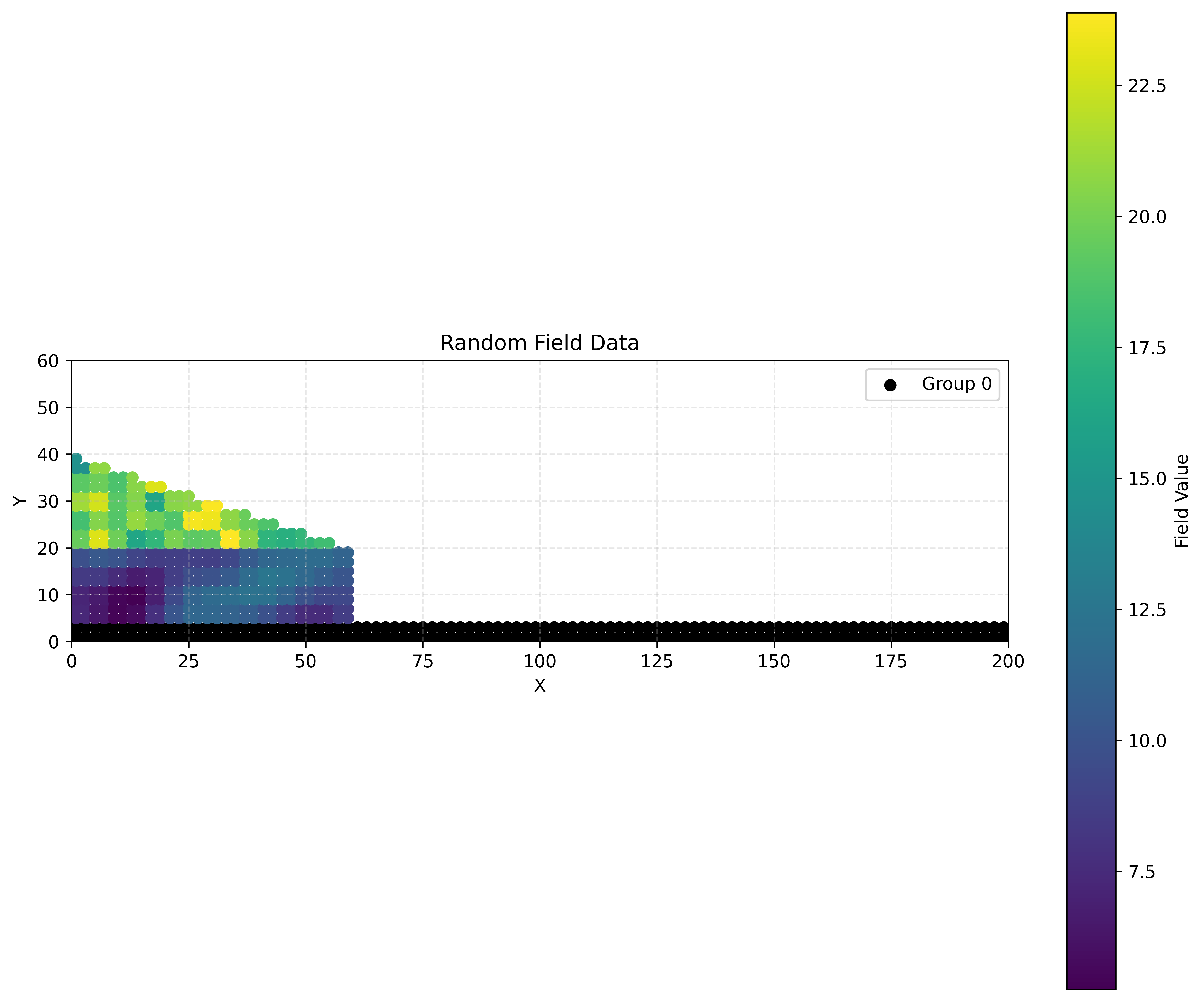
Make MP model for sand random field
This example generates material point method model from user-defined polygons and random field parameters.
import sys
import trimesh
import utils
from mpm import MPMConfig
import demo_utils
from functools import partial
import numpy as np
import vis_utils
import os
import trimesh


save_dir = './sand_random_field'

# Set config
lx, ly = 200.0, 60.0
mpm = MPMConfig(domain_origin=[0, 0], domain_length=[lx, ly])

# Mesh
cell_size = 4
mpm.add_mesh(
    n_cells_per_dim=[int(lx/cell_size), int(ly/cell_size)])

# Add materials
bedrock = [
        {
            "id": 0,
            "type": "LinearElastic2D",
            "density": 1800,
            "youngs_modulus": 50000000.0,
            "poisson_ratio": 0.3
        }
    ]

# Particles
# Bedrock
mpm.add_particles_from_lines(
    layer_info=[
        {
            "line_points": [[0, 4], [300, 4]],
            "material_id": 0,
            "particle_group_id": 0
        }
    ],
    n_particle_per_cell=2
)
# Slope
mpm.add_particles_from_random_field(
    polygons_params=[
        {
            "polygon_points": [[0, 4], [60, 4], [60, 20], [0, 20]],
            "random_params": {"mean": 12.0, "std": 2.0, "len_scale": 10.0},
        },
        {
            "polygon_points": [[0, 20], [60, 20], [0, 40]],
            "random_params": {"mean": 20.0, "std": 2.0, "len_scale": 2.0}
        }
    ],
    n_particle_per_cell=2
)
mpm.remove_overlapping_particles(overlap_tolerance=0.001)
mpm.define_particle_entity()

# Material
mpm.add_materials(materials=bedrock)
mpm.add_materials(option="random_field", material_type="MohrCoulomb2D")

# Boundary constraints
mpm.define_boundary_entity()
mpm.add_velocity_constraints(
    [
        {"axis": "x", "bound_loc": "start", "velocity": 0.0},
        {"axis": "x", "bound_loc": "end", "velocity": 0.0},
        {"axis": "y", "bound_loc": "start", "velocity": 0.0},
        {"axis": "y", "bound_loc": "end", "velocity": 0.0},
        {"axis": "z", "bound_loc": "start", "velocity": 0.0},
        {"axis": "z", "bound_loc": "end", "velocity": 0.0}
    ]
)
mpm.add_friction_constrains(
    [
        {"axis": "x", "bound_loc": "start", "sign_n": -1, "friction": 0.38},
        {"axis": "x", "bound_loc": "end", "sign_n": 1, "friction": 0.38},
        {"axis": "y", "bound_loc": "start", "sign_n": -1, "friction": 0.38},
        {"axis": "y", "bound_loc": "end", "sign_n": 1, "friction": 0.38},
        {"axis": "z", "bound_loc": "start", "sign_n": -1, "friction": 0.38},
        {"axis": "z", "bound_loc": "end", "sign_n": 1, "friction": 0.38}
    ]
)

# External loading conditions
mpm.add_external_loadings(
    {"gravity": [0, -9.81]}
)

# Analysis settings
mpm.analysis({
    "mpm_scheme": "usf",
    "locate_particles": False,
    "dt": 1e-04,
    "damping": {
        "type": "Cundall",
        "damping_factor": 0.05
    },
    "resume": {
        "resume": False,
        "step": 0,
        "uuid": "sand2d"
    },
    "velocity_update": False,
    "nsteps": 225000,
    "type": "MPMExplicit2D",
    "uuid": "sand2d"
})

# Post-processing
mpm.post_processing({
    "path": "results/",
    "output_steps": 375,
    "vtk": [
        "displacements",
        "stresses"
    ]
})

# Save mpm json that will be used after stress initialization
mpm.mpm_json["mesh"]["particles_stresses"] = "particles-stresses.txt"
mpm.write(save_dir=save_dir, file_name='mpm-resume.json')

# mpm json for stress initialization
mpm.mpm_json["mesh"].pop("particles_stresses")
mpm.mpm_json["analysis"]["uuid"] = "sand2d-le"
for particle in mpm.mpm_json["particles"]:
    # Set all materials to bedrock
    particle["generator"]["material_id"] = 0
mpm.mpm_json["analysis"]["resume"]["resume"] = False
mpm.mpm_json["analysis"]["resume"]["uuid"] = "sand2d-le"
mpm.mpm_json["analysis"]["nsteps"] = 70001
# Overwrite
mpm.write(save_dir=save_dir, file_name='mpm-le.json')

# vis_utils.plot_scatter(mpm.particle_groups, mpm.domain_ranges, f'{save_dir}/particle_config.png')
vis_utils.plot_random_field_data(
    mpm.particle_groups, mpm.domain_ranges, f'{save_dir}/random_field_data.png')

# Save the current script
# Get the path of the currently running script (main.py)
current_script_path = os.path.abspath(__file__)
utils.save_script(
    current_script_path,
    save_path=f'{save_dir}/input_script.py')